Intro and Recap
The NI Stroke Services Consultation 2019 aims to create Hyperacute stroke units attached to acute stroke units, while cutting existing stroke units “to as few as sites as possible” to consolidate staff.
This is a consultation like no other, where the Department of Health is inviting people all over Northern Ireland to decide which stroke units will be kept or closed. If all acute stroke units in Northern Ireland had an equal chance – this would be fair consultation – but they do not.
Some entire Councils have been omitted completely. (E.g. Newry, Mourne & Down locality, and its population of 179,000 people).
There are Six Options in the Questionnaire of preferred hospital sites to choose for Hyperacute/Acute Stroke Units in Northern Ireland.
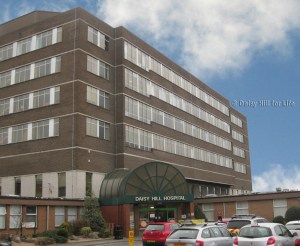
In this NI Stroke Consultation the existing acute stroke units in Daisy Hill, Newry and Causeway in Coleraine are excluded and do not even get a chance to be selected, because they do not appear anywhere in the Six Options.
These excluded populations are not even given the Option to voice their discontent with being left out – as the Options Question does not have a neutral or ‘Disagree’ or ‘None of the above’ Option.
At the other end of the spectrum, appearing six times, in each available Option are the stroke units in Altnagelvin, Craigavon and Royal Victoria Hospitals. Their continuation has been pre-determined and recruitment for their foretold Hyperacute stroke Units may have already started.

WE PRE PAY FOR EMERGENCY SERVICES INCLUDING STROKE & HEART
Hospital services are paid for with public money –general taxation, national insurance contributions and rates (including business rates).
All adults in Northern Ireland prepay for their life saving emergency care and hospitals, but this consultation downgrades Stroke from a time dependant Emergency service (which includes immediate vital CT scanning to confirm if patients are eligible for Thrombectomy and for Thrombolysis.
It divides our society into the have (emergency stroke care) or have not.
NI CONSULTATION DOCUMENT DOES NOT FULLY FOLLOW THE RESEARCH EVIDENCE REFERRED TO
The NI Stroke Consultation 2019* has stated various research to justify the choices that have been made, determining which hospitals will keep or lose their acute stroke units in Northern Ireland – but the very supporting research referred to, does not fully back up these configurations. Two Topic examples are given below.
[TOPIC 1]:
RECONFIGURATION OF STROKE SERVICES IN LONDON
Bengoa and the NI Department of Health Reshaping Stroke Services 2019 have referred to the London Stroke (Model) as a good example to follow in Northern Ireland.
The main NI Stroke Consultation Document (like the Bengoa Report 2016**), implies that in London after Reconfiguration, the number of stroke units were REDUCED from 30 acute stroke units to 8 Hyperacute stroke units (HASUs) (see pg p25)
THIS IS NOT WHAT HAPPENED.
FACT: FOLLOWING RECONFIGURATION IN LONDON, 30 STROKE UNITS REMAINED and 8 OF THESE ARE HYPERACUTE STROKE UNITS (HASUs).
The fact is – that AS WELL as these 8 HASUs (Hyperacute SUs)- 22 stroke units ALSO remained and to this day provide continued specialist treatment and intensive rehabilitation. (8 of these are attached to the HASUs) Confirmation of this can be seen in the latest Royal College of Physicians Sentinel Audit. (see Background Information Source 3*** ).
LOCAL STROKE UNITS ARE CRUCIAL IN THE STROKE PATHWAY
The 2010 London Stroke Model dealt with the complete stroke pathway including from 999 call to Hyperacute (HASU) and Stroke Unit (SU) care – where patients receive most of their care.
The London Stroke Consultation document advised the public:
“You will stay in the hyper-acute stroke unit for the first 72 hours, or until you are stable. You will then be transferred to a dedicated local stroke unit in the same hospital or closer to your home where you will receive continued specialist treatment and intensive rehabilitation. CARE IN A LOCAL STROKE UNIT WILL SIGNIFICANTLY IMPROVE YOUR CHANCES OF RECOVERING FROM A STROKE.”
This quote above from the London Consultation confirms the IMPORTANCE OF THE REMAINING 22 STROKE UNITS in London which provide both specialist treatment (some including thrombolysis) and intensive rehabilitation. They are known as non-routinely admitting stroke units in the Royal College of Physicians Sentinel SSNAP AUDIT.

[TOPIC 2]
UNIVERSITY OF EXETER
UNIVERSITY OF EXETER ADVISES THAT EFFICIENT TRANSFERS TO LOCAL STROKE UNITS WILL BE NEEDED.
As stated in the Research documents which were commissioned for the NI Stroke Consultation 2019, the research concentrated only on proposed Hyperacute stroke units and the Thrombectomy Unit in the Royal Victoria, Belfast with the understanding that EXISTING ACUTE STROKE UNITS WOULD CONTINUE TO EXIST.
The University of Exeter Research**** (p31) states:
“We assume that patients are taken to their closest stroke unit first”.
>This information is vitally important as statements in the research do not support the closing of existing Stroke units in Daisy Hill in Newry or Causeway in Coleraine.
In fact the research actually supports the important role of transfers to local stroke units. The research paper (University of Exeter p38)states:
“NI only focuses on the Hyper Acute Stroke Unit phase of stroke care and does not extend to organisation of ongoing step-down care in local stroke units, or after discharge home. We have also not modelled bed use in a reconfigured system; though IT IS LIKELY THAT EFFICIENT TRANSFERS BACK TO LOCAL STROKE UNITS WILL BE REQUIRED to prevent overload in the thrombectomy centre (and possibly the other local HASUs).

IN CONCLUSION
The NI Reshaping Stroke Care consultation document does not fully follow the research evidence referred to and the Questionnaire provided has biased Options which completely excludes existing Acute stroke units in Daisy Hill Hospital, Newry City and Causeway Hospital, Coleraine.
If this goes ahead unchallenged – Newry Mourne and Down Council – the 3rd highest Local Government District in NI with a population of 179,000 people (with 105,300 residents in rural areas) will be left with no immediate access to a designated specialist stroke unit (either Hyperacute or Acute Stroke Unit) vital for saving lives.
Stroke patients will be denied immediate access to this 999 crucially time dependant Emergency stroke service including timely access to the existing Daisy Hill, Newry City, specialist Acute Stroke /Rehabilitation Unit as a ward of first admission – a key recommendation of the Royal College of Physicians.
Daisy Hill Acute Hospital specialist stroke unit has been in existence since pre 2002 and already has saved thousands of lives, thanks to its entire specialist frontline staff.
It is up to us and our representatives to keep it there.
We have a right to continue to challenge, at every opportunity, these vital healthcare decisions.

ACTION NEEDED
Both of these issues must be rectified with immediate effect.
Please write to all your representatives, and to the Department of Health to sort this out before an unjust decision on the entire future of stroke units is made in Northern Ireland.
Background Information Sources
- *Department of Health NI (2019) Reshaping Stroke Care – Saving Lives, Reducing Disability. Consultation 2019 – see p25 for partial London Centralisation quote.
- **Department of Health NI (2016) Systems, Not Structures – Changing Health and Social Care – Expert Panel Report (Bengoa Report) Page 72 for partial London Centralisation quote.
- ***Royal College of Physicians Sentinel Audit RCP SSNAP Audit 2018 – List of Hyper-acute Stroke Units and Stroke units in London
There are still 30 STROKE UNITS IN LONDON: 8 of these are called Hyperacute Stroke Units (HASUs and SUs).
8 HASUs in London :
Queens Hospital Romford HASU / Royal London Hospital HASU / Charing Cross Hospital HASU / Kings College Hospital HASU / Princess Royal University Hospital HASU / Northwick Park Hospital HASU / St George’s Hospital HASU / University College Hospital HASU /
22 Stroke Units in London: 8 of these are attached to Hyperacute Stroke Units.
[Queens Hospital Romford SU] / Newham General Hospital /Whipps Cross University Hospital /
[Royal London Hospital SU] /Chelsea & Westminster Hospital /West Middlesex University Hospital /
Croydon University Hospital / St. Helier Hospital / St Thomas Hospital / Hillingdon Hospital /
Homerton University Hospital / [Charing Cross Hospital SU], Nine South Ward /[Princess Royal University Hospital SU] / [Kings College Hospital SU]/Kingston Hospital /University Hospital Lewisham /[Northwick Park Hospital SU] /North Middlesex University Hospital SU / Barnett General Hospital /
Royal Free Hospital / [St George’s Hospital SU] / [University College Hospital SU] /
- ****University of Exeter stroke modelling. Dr. Michael Allen, PhD et al. ‘Northern Ireland hyper-acute stroke care modelling: Maximising sustainability of services and clinical benefit from thrombolysis and thrombectomy.’ (p31, p38)
Link: https://www.health-ni.gov.uk/…/he…/rscs-stroke-modelling.pdf
You can follow the Daisy Hill Acute Hospital campaign also by visiting and liking our Facebook page at https://www.facebook.com/daisyhillforlife/ – Thank you.
© Daisy Hill for Life on Facebook and http://www.savedaisyhillhospital.com, 2015 – 2019. We welcome sharing of excerpts & links, provided that full and clear credit is given to http://www.savedaisyhillhospital.com and Daisy Hill for Life with appropriate and specific direction to the original content. Thank-you!
 Daisy Hill Hospital for Life