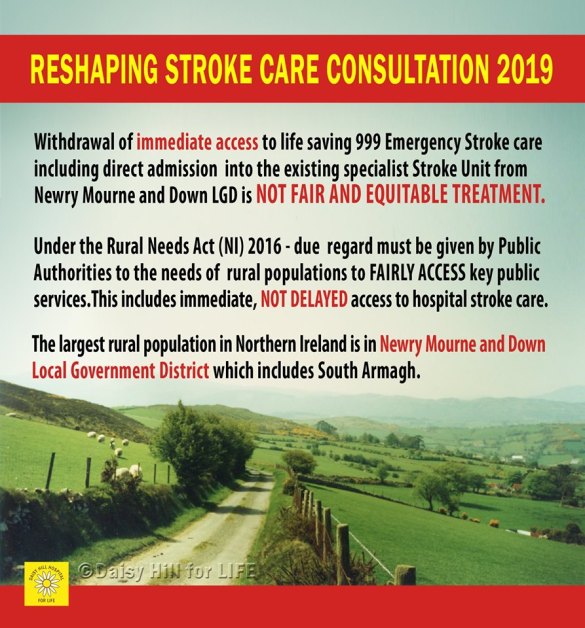
Under the Rural Needs Act (NI) 2016 due regard must be given by Public Authorities to the needs of rural populations to fairly access key public services. This includes immediate, not delayed access to hospital stroke care.
The largest rural population is in Northern Ireland is in Newry, Mourne & Down Local Government District which includes South Armagh.
Since 2018, the Rural Needs Act 2016 (NI), which aims to deliver fairer and more equitable treatment in Rural areas, must be adhered to by all Public bodies in NI. Because of this, the Dept. of Health filled in a Rural Needs Assessment Form to accompany the 2019 NI Stroke Consultation.
Definition of Rural in Rural Needs Assessment Form
On this form, the definition of “Rural” which according to the DOH “is better able to distinguish between those who will be MOST IMPACTED by additional travel times caused by proposed changes to services is:
“Populations outside of a 30 minute drive time of Derry/Londonderry or Belfast”
Using the above definition confirms that the 5 Urban hospitals in the Stroke Consultation 2019 are:
Altnagelvin, Royal Victoria, Craigavon, Antrim and Ulster hospitals,
while there are only three Rural Acute hospitals:–
Daisy Hill, Newry, Causeway Hospital, Coleraine and South West Hospital, Enniskillen.
The DoH’s reply to Question 2B in the Rural Needs Assessment states:
“The key impact that differently affects rural dwellers is likely to relate to travel times to hospital etc.” They continue:
“ALL OF THE OPTIONS outlined in the consultation document INCLUDE the provision of hospital care” at “Altnagelvin, Craigavon and Royal Victoria Hospital” (all URBAN Sites.) “Therefore people living in the catchment areas for these three sites WILL NOT experience any increase in respect of travel times. Under the potential options, people living in the catchment areas for Causeway Hospital and Daisy Hill Hospital, WOULD experience an INCREASE in journey times if taken to hospital after a suspected stroke.”
INCREASE IN JOURNEY TIMES AFTER A SUSPECTED STROKE FOR RURAL CATCHMENT AREAS
From research by Werner Hacke, MD It is known that the drug “Alteplase” used in Thrombolysis, is nearly twice as effective when administered WITHIN the first 1.5 hours after stroke as it is when administered 1.5 to 3 hours after stroke.
Yet, The DoH have admitted, above, that there WILL BE AN INCREASE IN JOURNEY TIMES for people living in the Rural Catchment areas of Causeway and Daisy Hill hospitals, and that people living in the Urban catchment areas of Altnagelvin, Craigavon, and Royal Victoria hospitals WILL NOT experience any increase in respect of travel times.
They have decided also to WITHDRAW COMPLETELY the existing stroke units in the Rural Locations of Daisy Hill Acute Hospital, Newry and Causeway Hospital, Coleraine. This proposal means dying stroke patients from these Rural localities will have to TRAVEL FURTHER for the CRITICALLY TIME DEPENDENT, LIFE-SAVING drug Alteplase used in Thrombolysis, and direct access from ED into the existing combined Specialist Acute/Rehabilitation Stroke Units in Daisy Hill, Newry, and Causeway Hospital, Coleraine, essential to save lives.
The 3 Urban Hospitals Altnagelvin, Craigavon, and Royal Victoria will never experience an increase in travel times because they feature in all 6 Options in the 2019 Stroke Questionnaire to be upgraded to Hyperacute stroke units with co-located Acute Stroke Units.
RURAL HOSPITALS OF DAISY HILL AND CAUSEWAY OMITTED FROM ALL SIX OPTIONS
However the two Rural hospitals of Daisy Hill and Causeway have been omitted altogether from all six options, confirming they will be shut down as if they never existed as part of the network providing 999 Emergency Stroke care to the population of NI.
THERE ARE NO RURAL HOSPITALS INCLUDED IN ALL 6 OPTIONS FOR HYPERACUTE AND ACUTE STROKE UNITS.
The DOH forget that Rurality is a factor in allocating Health and Social Care Funding which means that there is extra money to provide services in Rural areas which should be taken into account in deciding where stroke Units will be provided.
*********RURAL NEEDS ACT (2016)*************
To have Three Hyperacute stroke units for Urban Areas of NI in all 6 Options and NO Option for a Hyperacute Stroke Unit for the Catchment population for the LARGEST RURAL POPULATION in NI namely Newry, Mourne & Down (which includes S.Armagh) Local Government District is NOT FAIR AND EQUITABLE TREATMENT in revising policies, strategies and plans, and designing and delivering public services such as Acute Stroke Care under the 2016 Rural Needs Act.
The Rural Needs Act NI 2016, (which is not a devolved matter) is there to PROTECT the Rural Population from this unfair treatment and “can relate to the ability to access key public services such as health, the ability to access suitable employment opportunities, and the ability to enjoy a healthy lifestyle”.
NEWRY MOURNE & DOWN LOCALITY SHOULD ALREADY HAVE A MAJOR ACUTE HOSPITAL
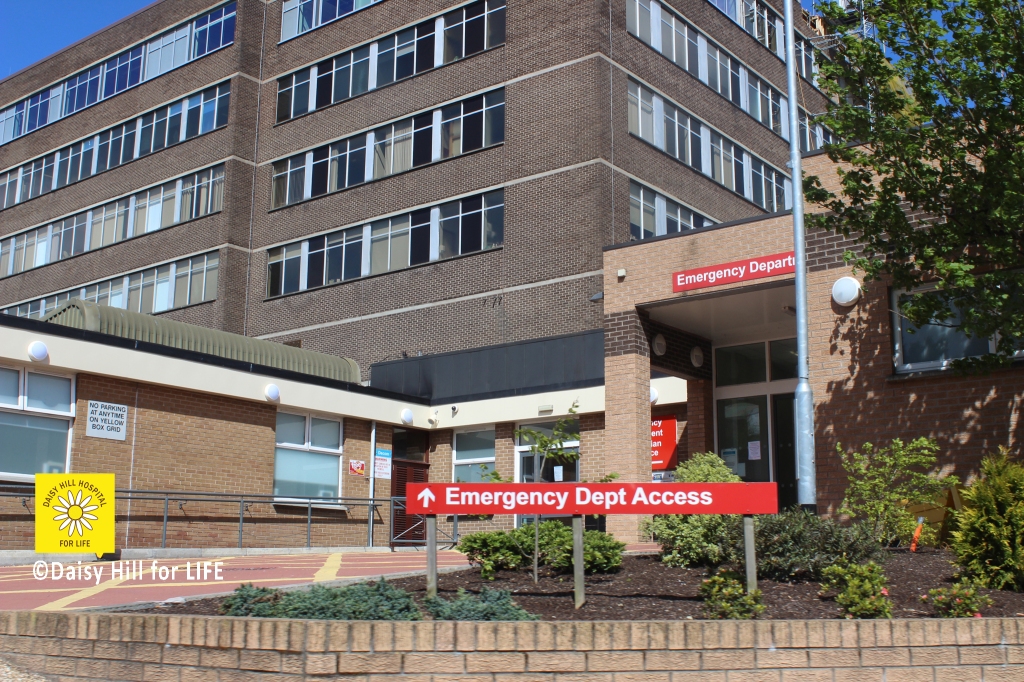
There is no doubt that Newry Mourne and Down LGD with the largest Rural population in NI with 179,000 people, SHOULD ALREADY have a major acute hospital, in Newry as proposed by Secretary of State Peter Hain in 2005.
This Stroke consultation shows that the Department of Health are not even prepared to give dying stroke patients from the largest rural Population in NI, the basic essential need of immediate access to Emergency Stroke Care.
The Rural catchment population for Daisy Hill Acute Hospital, Newry, is not being treated fairly and equitability in the same way as the catchment population of the Urban Stroke Units in Altnagelvin, Craigavon and Royal Victoria Hospitals who will have immediate access, as they should, to life saving stroke care, in Hyperacute and Acute Stroke Units without having to travel further than at present.
This deliberate plan to exclude the Rural populations need for IMMEDIATE, not delayed, access to life saving Emergency Stroke Care, including CT scanning and Thrombolysis, followed by direct access into a specialist Hyperacute Stroke Unit /Acute Stroke Unit will COST LIVES, not save lives of Stroke patients and should not be condoned.
. . . . . . . . . . . . . . . . . . . . . . . . . . . . . .
BACKGROUND INFO
Link to Rural Needs Act 2016
https://www.legislation.gov.uk/…/19/pdfs/nia_20160019_en.pdf
“RURAL NEEDS ACT (NORTHERN IRELAND) 2016
Duty of public authorities to have due regard to rural needs
1.(1) A public authority must have due regard to rural needs when— (a) developing, adopting, implementing or revising policies, strategies and plans, and (b) designing and delivering public services.
6. In this Act— “the Department” means the Department of Agriculture and Rural Development; “rural needs” means the social and economic needs of persons in rural areas.”
‘PUBLIC AUTHORITIES’ include:
A Northern Ireland department
A district council
A Health and Social Care Trust
Invest Northern Ireland
The Regional Agency for Public Health and Social Well-Being
The Regional Health and Social Care Board
© Daisy Hill for Life on Facebook and http://www.savedaisyhillhospital.com, 2015 – 2024. We welcome sharing of this info and the use of excerpts and links, provided that full and clear credit is given to http://www.savedaisyhillhospital.com and Daisy Hill for Life with appropriate and specific direction to the original content. Thank-you!
See also: https://en-gb.facebook.com/daisyhillforlife for more posts on this topic.
 Daisy Hill Hospital for Life