Newry & Mourne Local Government District (LGD) has consistently ranked in the Top 4 populations by population size of LGDS in all N. Ireland consistently since 1971 – So where’s the Funding for Daisy Hill Acute Hospital, Newry?
Now is finally the time for proper investment for Daisy Hill, as Newry & Mourne LGD has a population bigger than Antrim LGD, Castlereagh LGD, and also Craigavon LGD, who all have MAJOR ACUTE HOSPITALS ALREADY.

Now is finally the time for proper investment for Daisy Hill, as Newry & Mourne LGD has a population bigger than Antrim LGD, Castlereagh LGD, and also Craigavon LGD, who all have MAJOR ACUTE HOSPITALS ALREADY.
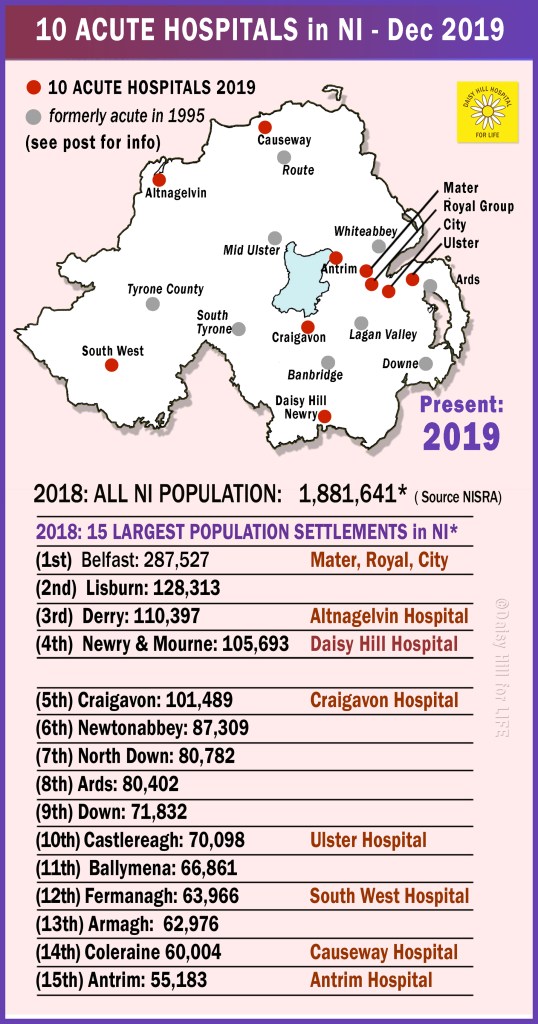
The picture shows the Present configuration of 10 Acute hospitals (red dots) now left in NI in 2019, alongside a Table of the 15 largest population settlements here (Source 2018 NISRA*).
There has been a Hospital on the Daisy Hill Hospital site in Newry since the 19th century, for its growing Population. In 2003 it was officially designated as one of ten out of 19 existing Acute hospitals, under ‘Developing Better Services’ needed for the acute care needs of the people of NI.
But despite Newry & Mourne consistently having the largest LGD population in the operational area of the Southern Trust**, its funding for Acute services and Capital for Redevelopment as a MAJOR ACUTE HOSPITAL has never been equal to the other acute hospital in the Southern Trust, Craigavon.
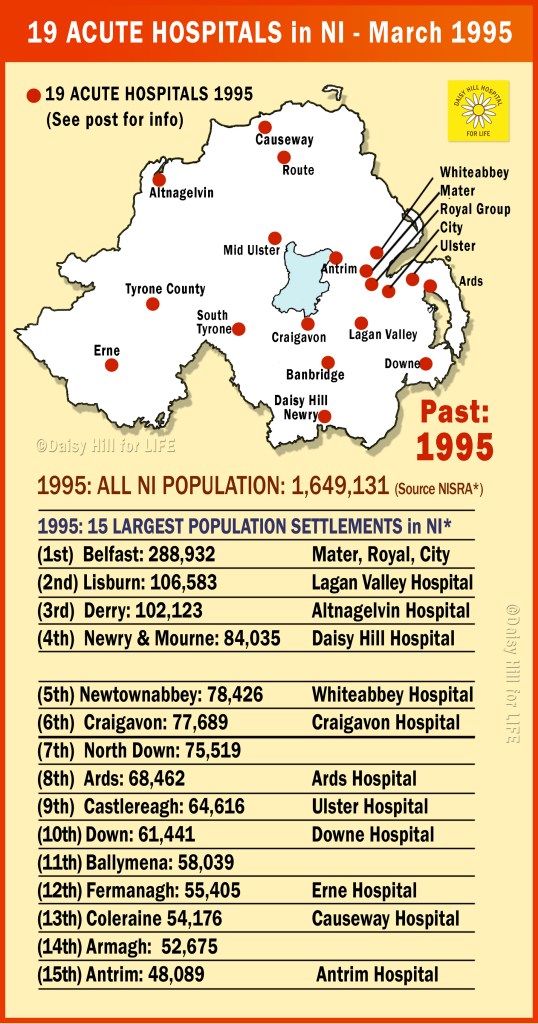
The 19 acute hospitals in NI in 1995 were reduced to a total of ten after various Dept. of Health Reforms. The LGD populations* or Settlements shown in the Graphic (source NISRA*) would suggest that Population size and need does not seem to drive current funding decisions. Health investment in NI continues to focus on 4-6 Hospitals, instead of the ten designated acute hospitals on the map.
Only 6 URBAN hospitals (Royal, Belfast City, Craigavon, Antrim, Altnagelvin and the Ulster) continue to be allocated major funding.
These 6 hospitals, (from the previous 19) were given major investment as specialist acute hospitals, because of hospital size, NOT based on where the largest LGD/settlements of population lived, [Regional Strategy for 1997 to 2002. – Detail available in previous article, link at the end of piece.]
>DAISY HILL ACUTE HOSPITAL, IN NEWRY & MOURNE LGD IS STILL BEING OVERLOOKED DESPITE BEING THE LARGEST LOCALITY OF ALL 5 LGDs IN SOUTHERN TRUST AREA & FOURTH LARGEST LGD IN N.IRELAND.
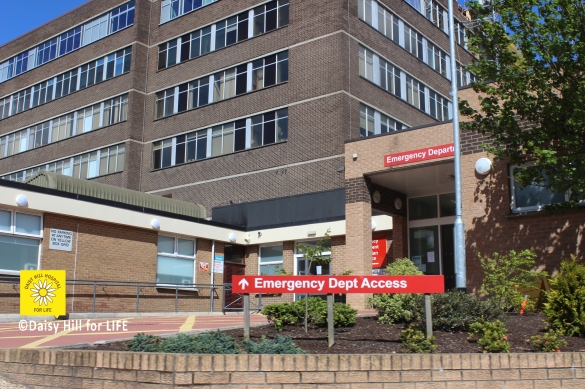
Daisy Hill acute Hospital, in Newry & Mourne LGD is still being overlooked for investment and specialist service provision, without explanation.
Official NISRA demographic statistics prove that the population need exists in the area of Newry & Mourne (which includes South Armagh). This LGD has consistently been the FOURTH largest population in NI, as well as the highest locality population of all 5 localities/LGDs in the operational area** of the Southern Health Trust since its inception in 2007.

TIME NOW FOR PROPER INVESTMENT FOR NEWRY & MOURNE LOCALITY ACUTE HOSPITAL, DAISY HILL, INCLUDING INVESTMENT IN STROKE SERVICES, SCANNING EQUIPMENT AND HOSPITAL CAPITAL PRIORITIES
If Health Chiefs and those in charge of funding were to fully realise the actual size of the Newry & Mourne population, from valid NISRA statistics, then changes could be made to rectify the situation and put a stop to the wrong categorisation of Daisy Hill as a ‘smaller’ Hospital, when it should be a large Specialist Acute Hospital to truly reflect the population size and need in the area.
For example Even though the Executive Summary of the Bengoa Report*** P19 stated clearly to the NI Executive “IT IS NOT APPROPRIATE for this report to dictate to people in different parts of Northern Ireland what services they should and should not expect to be located in their area or local hospital” THEY DID EXACTLY THAT in THE FULL BENGOA EXPERT PANEL REPORT (P.73)
In this report all of Northern Ireland was inappropriately dictated to and told as a Local Case Study that Craigavon Area Hospital would be the site for a centralised Specialist Stroke Unit above all other locations in NI. Newry & Mourne’s population were also publicly inappropriately dictated to, that they would only get stroke rehabilitation in a community setting instead of retention of the existing Specialist Acute/Rehabilitation Stroke Unit in Daisy Hill acute Hospital.
NOW IS THE TIME FOR CHANGE & PROPER INVESTMENT
The Newry & Mourne population was left out of plans for future investment for a NEW hospital, left out of the NI 2019 Reshaping Stroke Services Options and IGNORED when it came to funding and long term future investment for CT, MRI and non obstetric scanners but NOW IS THE TIME FOR CHANGE.

>NOW is the time for proper investment (with Rebates) for Newry & Mourne and Daisy Hill Hospital as a Specialist Acute Hospital NOW, just as had been intended under Government Backed Report in 2003 and Strategic Investment Report in 2005 which had Secretary of State backing.
PLEASE SHARE WIDELY
Please Share widely – with your help this info could reach the right people with the power to make the necessary changes, such as the new Health Minister Mr Robin Swann MLA and new Finance Minister Mr Conor Murphy MLA. Please keep supporting Daisy Hill Hospital for Life!
< BACKGROUND INFORMATION >
Reference * NISRA is the Northern Ireland Statistics and Research Agency ; https://www.nisra.gov.uk/
IMPORTANT INFO ON LGDs AND COUNCILS
Despite the fact that there are now 11 Councils in Northern Ireland in 2020, the (former) 26 council model is still relevant today for the purpose of Health Funding.
NISRA continues to also provide populations by HSC Trusts aggregated from the former 26 local government districts. These 26 former LGDs remain named in legislation as the ‘operational areas’ of the Health and Social Care Trusts in NI according to the Establishment Orders 2006.
Reference ** The 5 LGDs named in the’ OPERATIONAL AREA’ of the Southern Health and Social Services Trust (SHSCT) – in order of population size since the start of the Southern Trust in 2007 were in 2018 : Newry & Mourne (105,693); Craigavon ( 101,489); Armagh (62,976); Dungannon (62,666), and Banbridge(50,717) NISRA 2018 * Note: Newry & Mourne is ONE single LGD.
<Important>:
There are 5 LGDs/localities in SHSCT – NOT 3 Localities or Local Government Districts.
They are as follows:
(1) Newry & Mourne: ONE LGD,
(2) Craigavon: one LGD
(3) Banbridge: one LGD ,
(4) Armagh one LGD,
and (5) Dungannon :one LGD.
THERE IS NO SUCH LGD/LOCALITY AS ‘ARMAGH/DUNGANNON’ or ‘CRAIGAVON/BANBRIDGE.’
Southern Trust/ SLCG Populations
1995 Southern Trust /Southern Local Commissioning Group SLCG Populations: Newry & Mourne (84,035); Craigavon (77,689); Armagh (52,675); Dungannon (46,958) and Banbridge(37,427) NISRA 1995.
2010 Southern Trust/ SLCG Populations: Newry & Mourne (99,900); Craigavon (93,600); Armagh (59,400); Dungannon (57,700) and Banbridge (48,000). NISRA MYE 2010
2018 Southern Trust/ SLCG Populations: Newry & Mourne (105,693); Craigavon (101,489); Armagh (62,976); Dungannon (62,666) and Banbridge (50,717) . NISRA 2018
Reference *** Bengoa Expert Panel Report ‘Systems not Structures’, 2016, https://www.health-ni.gov.uk/publications/systems-not-structures-changing-health-and-social-care-full-report
Information on this and other similar topics is also available at the companion Facebook page https://www.facebook.com/daisyhillforlife/ – Thank you. Please Follow or Like the Page to receive updates.
© Daisy Hill for Life on Facebook and http://www.savedaisyhillhospital.com, 2015 – 2024

 Daisy Hill Hospital for Life