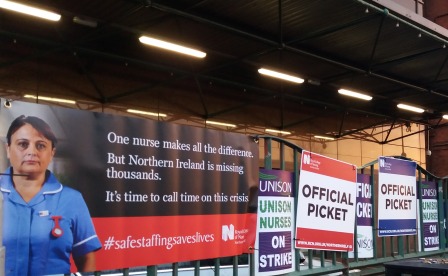
2019 ended with Northern Ireland’s Health Care in crisis: Patient Waiting lists at record highs, healthcare workers on strike over pay and staffing levels, Nurses from the Royal College of Nursing on strike for the first time in its 103 year history. This ‘crisis’ is recognised by the Royal College of Surgeons, the Royal College of Nursing and Health Unions
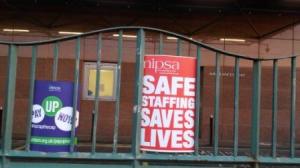
Health Care workers on strike here have been short changed in comparison with the rest of the UK, on pay and staffing levels. But in terms of Acute Hospital Care, are people in Northern Ireland being treated fairly in the number and location of specialist acute hospitals?
Before NI can start to fix the current Health Care Crisis –some background is necessary to find out how it got to this point.
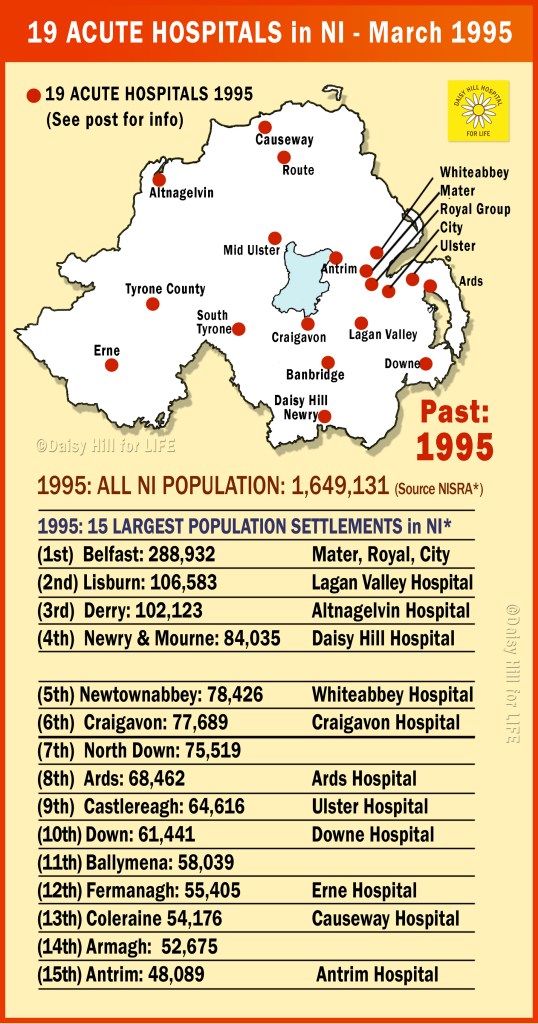
There were 19 Acute hospitals in NI in 1995 as the map below, reproduced from The Department of Health’s Regional Strategy (1997 – 2002) shows.
According to the Department of Health:
“If the ratio of acute hospitals to population which currently obtains in England were applied to Northern Ireland (1,649,131 in 1995) there would be no more than 10 acute hospitals in NI. Thus many acute hospitals in NI serve much smaller populations than acute hospitals in England.”
Dept. of Health for Northern Ireland Regional Strategy (1997 – 2002)
Direct Rule Health Minister Mr Moss stated in a Hansard Report 5 March 1997:
“The Department’s Regional Strategy for 1997 to 2002 was published last year and envisaged specialised acute hospital services being built around the cornerstone of Northern Ireland’s six major hospitals- the Royal Victoria hospital, the Belfast City hospital, Craigavon, Antrim, Altnagelvin and the Ulster.”
It clearly states also that:
“While investment where appropriate will be made in other hospitals, it is expected that those SIX HOSPITALS will provide the main focus for FUTURE INVESTMENT in INPATIENT FACILITIES.”
Dept. of Health for Northern Ireland Regional Strategy (1997 – 2002) p65
These 6 hospitals out of 19 hospitals were envisaged as specialist acute hospitals, because of hospital size, NOT based on where the largest settlements of population lived, compared to England who the strategy stated would have 10 hospitals for a population the size of NI (1,649,131). The mid-year 1995 NISRA populations (Table) prove this.
They show that Daisy Hill acute Hospital, Newry & Mourne LGD – the FOURTH largest population (84,035) in NI, and Lisburn LGD (106,583), the SECOND Largest population in NI were COMPLETELY IGNORED for consideration as one of 6 major acute hospitals, while 3 other acute hospitals serving SMALLER populations in the local Government Districts of Craigavon, (population 77,689) Antrim (48,489), and Castlereagh (64,616) were listed for preservation.
Accurate population demographics, as provided by NISRA must inform health planning and future investment in inpatient facilities across NI
This trend of ignoring population size has continued into the present (as the next post will show), so to truly combat the Northern Ireland wide health crisis – ACCURATE DEMOGRAPHICS provided by NI Statistics and Research Agency (NISRA) must inform health planning. This includes using these official statistics, as presented by NISRA to determine WHERE Specialist acute Hospitals and specialist inpatient and outpatient acute services are located.
Acute Hospital accommodation and services are paid for through Rates and Taxes by everyone, irrespective of where they live in NI – Urban or Rural, everyone is entitled to equality of access to Hospital Care.
Further posts will look at the present and future NI Demographics in relation to location of acute hospital provision.

BACKGROUND
A Short History – Pre Centralisation – In 1995 there were 19 ACUTE HOSPITALS in Northern Ireland. (See Map or Full List at End of post.)
1995: All NI population: 1,649,131*
1995: 15 LARGEST POPULATION SETTLEMENTS IN NORTHERN IRELAND (Statistics from NISRA*)
(1st) Belfast: 288,932; (2nd) Lisburn: 106,583; (3rd) Derry: 102,123; (4th) Newry & Mourne: 84,035 (5th) Newtownabbey: 78, 426; (6th) Craigavon: 77,689 (7th) North Down: 75,519 (8th) Ards: 68,462 (9th) Castlereagh: 64,616 (10th) Down: 61,441.
[(11th) Ballymena: 58,039 (12th) Fermanagh: 55,405 (13th) Coleraine: 54,176, (14th): Armagh: 52,675 (15th) Antrim: 48,809 [NISRA]*
19 ACUTE HOSPITALS IN 1995 NI (Alphabetical order)
Altnagelvin (Derry); Antrim; Ards; Banbridge; Causeway (Coleraine); City (Belfast); Craigavon; Daisy Hill (Newry); Downe; Erne (Enniskillen); Lagan Valley (Lisburn) ; Mater (Belfast); Mid-Ulster(Magherafelt); Route (Ballymoney); Royal Group (Belfast); South Tyrone; Tyrone County (Omagh); Ulster (Castlereagh); Whiteabbey (Newtownabbey).
Sources:
NI Regional Strategy for Health and Social Wellbeing (1997- 2002) ‘Health and Wellbeing into the Next Millennium’
Information on this and other similar topics is also available at the companion Facebook page https://www.facebook.com/daisyhillforlife/ – Thank you. Please Follow or Like the Page to receive updates.
© Daisy Hill for Life on Facebook and http://www.savedaisyhillhospital.com, 2015 – 2024



 Daisy Hill Hospital for Life