NI Stroke Consultation: Call for Dept. of Health to Assess for Population Health and Rural Needs as Next phase of Work

NI Stroke Consultation -Call for Dept. of Health to Assess for population health and Rural Needs

Dept.of Health NI have stated in Hospital Reconfiguration Update Nov 2019 that 19,000 responses were submitted to NI ‘Reshaping Stroke Care’ Centralisation proposals and 4,500 responses received on proposed centralisation of NI Reshaping Breast Assessment Services.

The Department’s plans to proceed after these two consultations differ radically with a plan to carry out a Population Health Needs Assessment for BREAST ASSESSMENT but NOT FOR STROKE SERVICES.

The two statements on (1) Stroke and (2) Breast Assessment services appear below.
(1) Statement on ‘Reshaping Stroke Care’ services:

“A consultation on improving stroke services to improve outcomes launched in March 2019. The consultation document set out seven commitments to improve stroke care across the stroke pathway, alongside six potential options for the establishment of a hyperacute stroke network in Northern Ireland.
19,000 consultation responses were received. The Department is currently analysing consultation responses to inform the development of a preferred model for stroke care.”

Dept. of Health NI (DoH) 2019 Hospital Reconfiguration Update

(2) Statement on ‘Reshaping Breast Assessment Services’ :
“A consultation on proposals to improve breast assessment services ran from 25 March to 30 August 2019.
Over 4,500 responses have been received. The Department is currently analysing all responses. This will help to inform the next phase of work to review breast cancer treatment services which is commencing with a Population Needs Assessment. Further details will be announced in the weeks ahead.
Dept. of Health NI (DoH) 2019 Hospital Reconfiguration Update
Official statistics, as presented by NISRA must determine where Specialist acute Hospitals are located in NI.

POPULATION HEALTH NEEDS ASSESSMENT VITAL FOR BOTH STROKE SERVICES AND BREAST CANCER SERVICES.

The Department’s plan to carry out a “Population Health Needs Assessment” for Breast Cancer services as a next phase of work is a good proposal, but where is the plan to carry out a Population Health Needs Assessment for specialist emergency, inpatient, outpatient and rehabilitation treatment for Stroke Services covering the complete stroke pathway – across NI? THERE HAS NEVER BEEN ONE.

A failure to carry out accurate Population Needs Assessments for health services is a recurring theme in the Southern Trust area – NO NEEDS ASSESSMENT WAS UNDERTAKEN as part of the SOUTHERN TRUST STROKE CONSULTATION in 2014.

Despite this, the 2016 Full Bengoa Expert Panel Report used the controversial proposed removal of Specialist Acute Stroke services, and its specialist Acute Stroke staff, from Daisy Hill acute Hospital in Newry as the prime local Case Study for Centralising Stroke Services in NI.

The full Bengoa Report inappropriately promoted (quote below) the choice of Craigavon Hospital for a Specialist Stroke Unit, singled out ahead of all other NI hospitals, and WITH NO NEEDS ASSESSMENT.

This was proposed to make sure that Craigavon could have a 24/7 specialist Stroke Centre leaving Daisy Hill Newry without its existing life saving combined specialist Acute Rehabilitation Stroke Unit and its valuable specialist stroke staff.

“In 2014…, a decision was taken to create a single specialist stroke inpatient unit within the Southern Health and Social Care Trust, at Craigavon Area Hospital. The Trust is proposing to provide a consistent and specialist service 24/7 in one centre rather than spreading the specialist team of staff across four sites. Daisy Hill Hospital will continue to provide ongoing rehabilitation and support through community stroke teams working to a regionally agreed care model.”

Bengoa Expert Panel 2016 (Full Report) (pg 72/ 73).

WHY ASSESS NEED?

Population Needs Assessments are widely recognised as a statutory requirement for health commissioning across the UK to ensure fairness and to reduce inequalities. A Needs Assessment is absolutely vital to ensure that immediate access to stroke services is available for all NI stroke patients – not just those attending hospitals confirmed in all six options in the urban areas of in and around Belfast namely the Royal, Craigavon and Altnagelvin.

POPULATION NEEDS ASSESSMENT DATA MUST USE OFFICIAL NISRA STATISTICS

This Needs Assessment must be undertaken using accurate NISRA Local Government Districts Demographics – not by using (1) imaginary theoretical demand of 600 stroke patients to certain hospitals or (2) Integrated Care Partnerships (which vary across local government districts).

Neither is an accurate statistical representation of the POPULATION health needs of an area.
New investment in acute specialist hospital services, hospital beds and specialist medical staff is due in the Newry & Mourne area, in Daisy Hill Acute Hospital, including in the Emergency Department.

DEPT. OF HEALTH N.I. ARE FAILING TO ADDRESS THE HEALTH NEEDS OF NEWRY & MOURNE POPULATION

(1) Newry & Mourne LGD is consistently the HIGHEST POPULATION IN THE SOUTHERN TRUST OPERATIONAL AREA

(2) Newry & Mourne LGD is consistently the 4TH HIGHEST POPULATION IN NI -SINCE c1972

Newry and Mourne locality has always been the largest population of the 5 localities (LGDs) in the Southern Trust and must have investment for a Specialist Acute Hospital.

The DOH, PHA, HSCB and Commissioners need to take action to assess Population Health Needs and provide services for Newry & Mourne former LGD , (which includes South Armagh) both as:

(1) Newry & Mourne has been the consistently largest local government district that remains in the operational area of the Southern Trust since its inception in 2007. NISRA demographics confirm this.

Latest official population stats for the 5 LGDs in the operational area of the Southern Trust

(1)Newry & Mourne ( 105,693*); (2) Craigavon ( 101,489*); (3)Armagh(62,976*) (4) Dungannon (62,666*) and (5) Banbridge (50,717*) [ [2018* NISRA]. This has been consistently ignored by the Southern Trust since they came into operation in 2007.

(2) Newry &Mourne LGD has always been the 4th highest LGD population in NI since 1972 (for nearly 50 years) after only Belfast, Lisburn (Greater Belfast ) and Derry.

(3) NISRA demographics confirm the Newry & Mourne population is projected to be the 3rd HIGHEST LGD POPULATION IN THE WHOLE OF NI BY 2023 with 110,090 population after only (1st)Belfast (289,130) and (2nd) Lisburn (Greater Belfast): 133,106. Derry is projected to be the 4th highest population in NI with 110,028 (NISRA).

These demographics were not considered in the ‘Reshaping Stroke Care’ Consultation or by the Southern Trust. A population Health Needs Assessment using accurate statistics will show the DoH the population health needs within Newry & Mourne, including needs for specialist stroke services.

A Population Health Needs Assessment (at local Government District Level) using accurate NISRA demographics will show quite clearly the continued need for specialist Stroke staff in Daisy Hill acute Hospital combined Stroke Unit, in order to provide time crucial emergency, acute and rehabilitation stroke care for the Newry & Mourne population and further afield within the same time frame as in urban areas in NI.

Centralisation of stroke services to one area in Craigavon will not provide safe stroke care in Newry & Mourne and will cost lives.
Act FAST Stroke - HyperAcute Stroke Unit for Newry 2019

PHASE OF WORK REQUESTED:

CALL FOR THE DOH, PHA, HSCB and COMMISSIONERS TO:

1. Conduct a Full Population Health Needs Assessment at individual Local Government District level (not at Trust level) using official NISRA Statistics – not Administrative stats such as Integrated Care Partnerships or theoretical modelled hospital demand.
2. Carry out Full Rural Impact Assessment (Rural Needs Act 2016)
3. Carry out an Environmental Impact Assessment to assess the Carbon Footprint implications of Centralisation
Then
4. Rewrite the Stroke Consultation and Stroke Options following these assessments, based on population needs, along with the Consultation Responses.

WHY THE STROKE OPTIONS NEED TO BE RE-WRITTEN

Under “Change or Withdrawal of services” – ALL 8 existing specialist Acute Stroke Units (including Daisy Hill, Newry combined specialist Acute Stroke Rehabilitation Unit) , NOT JUST 6 STROKE UNITS are entitled to be included in an NI wide consultation questionnaire options for upgrading to Hyperacute stroke units and retained as Acute Stroke Units.

The finally selected options must ensure immediate access to Emergency and inpatient specialist stroke Care in a fair and regionally balanced way across NI

>>>>>BACKGROUND

Dept. of Health NI latest Update to NI 2019 ‘Reshaping Stroke Care’ Consultation can be seen at the following link:
https://www.health-ni.gov.uk/hrn-newsletter-edition1

For Bengoa Report: Systems not Structures: Changing Health & Social Care (FULL REPORT) (link Below) See pages 72/73
https://www.health-ni.gov.uk/topics/health-policy/systems-not-structures-changing-health-and-social-care

You can follow the Daisy Hill Acute Hospital campaign also by visiting and liking our Facebook page where you will find current information at https://www.facebook.com/daisyhillforlife/ – Thank you.

Enter your email address to subscribe to this blog and receive notifications of new posts by email.

© Daisy Hill for Life on Facebook and http://www.savedaisyhillhospital.com, 2015 – 2021. We welcome sharing of this info and the use of excerpts and links, provided that full and clear credit is given to http://www.savedaisyhillhospital.com and Daisy Hill for Life with appropriate and specific direction to the original content. Thank-you!
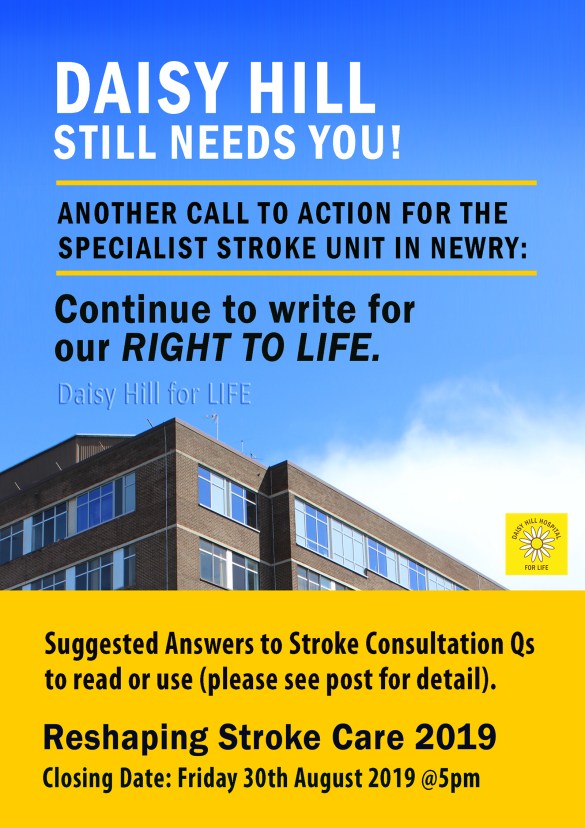

Another Call to Action for the Specialist Stroke Unit in Newry: Write for your rights!

Suggested Answers to the RSC Consultation NOW AVAILABLE – including the Extra 5 Equality, Human Rights & Rural impact Questions

As the 2019 Stroke Consultation Deadline is Fri 30th August, Daisy Hill’s campaign for Hyperacute Stroke Unit status continues, with a renewed call for action for the people of Newry & Mourne, South Armagh,  South Down and surrounding areas.

Based on demographics Daisy Hill Acute Hospital, Newry should be confirmed as a location for a Hyperacute and Acute Stroke Unit – so Suggested Answers to Reshaping Stroke Care are now ready to Download for sending back to the Department.

If you want to help but haven’t submitted any Response to the Consultation, OR if you have already signed a Support Our Stroke Services Questionnaire and need to answer the Equality Questions, both documents are available below.

1. For those YET TO REPLY to Re-shaping Stroke Care 2019 Consultation

ALL Questions Suggested Answers Version 1 (Complete Questionnaire)  is available to download and save as a new filename from this Link: All Qs Answers Reshaping Stroke Care questionnaire

OR

2. For Those who have Responded to the first Questions but not the EQUALITY\ RURAL IMPACT QUESTIONS in Reshaping Stroke Care 2019

5 EQUALITY Q’s ONLY Questionnaire is available to download and save as a new Filename from this link: 5 Equality Qs answers Reshaping Stroke Care Questionnaire

These Suggested answers are already typed onto the RSC Questionnaire in Word Format for easy access for you to download and read.  

The Answers are only intended to be a Guide for your own Answers – but if you agree with these and find it useful and time-saving– you can use all or part of the content.  You can type changes directly onto the Questionnaire, (adding or delete as you wish!) It is recommended that you do make some changes so they are not all identical. Please remember to add your name/address/email address too.

After Downloading, please remember to ‘Save As’ and Give the document a new filename – perhaps adding your Initials or Surname. For e.g. RSC_Questionaire_All_JSmith_2019

The Original RSC blank Questionnaire is available from the Department of Health NI website :  https://www.health-ni.gov.uk/reshaping-stroke-care . Click on ‘Reshaping Stroke Questionnaire’(Word doc) and save.

DIFFERENT WAYS TO RESPOND  

(1) EMAIL: Email your Questionnaire \answers to the Department of Health at:  StrokeConsultation@health-ni.gov.uk

(2) ONLINE: You can copy and paste some or all the Reshaping Stroke Care ‘suggested answers’ plus add your own comments onto the online questionnaire at:

https://consultations.nidirect.gov.uk/doh-healthcare-policy-group/reshaping-stroke-care-saving-lives-reducing-disabi/consultation/intro/

(3) BY POST (using First Class Stamp) post (before 4.30pm Wednesday 28th August 2019 at the latest) to:                

Reshaping Stroke Care, Hospital Services Reform, Department of Health, Annexe 3, Castle Buildings, Stormont Estate, Belfast BT4 3SQ    

If you know people that would like to respond to the Consultation, that do not have a computer or do not wish to respond online, forms are available from the Department of Health.

To get a form posted to you: Phone (028) 9076 5643 and ask for a RESHAPING STROKE CARE Consultation Questionnaire. It is advisable to do this as soon as possible as All Responses must be received by the DOH before the Deadline of Friday 30th August 2019 @5pm.

All the Consultation Documents (including the Questionnaire Form are available online at   https://www.health-ni.gov.uk/reshaping-stroke-care

IMPORTANT INFORMATION

THIS ACTION IS TO FURTHER SUPPLEMENT THE EXCELLENT WORK ALREADY DONE BY SUPPORT OUR STROKE SERVICES COMMITTEE

As you know, another Campaign Group, Support Our Stroke Services Committee organised Community Outreach events over the summer in Shops, Shopping Centres and local places to encourage people to sign Questions from the Online Questionnaire.  These Questionnaires supported the community goal to ensure that Daisy Hill Acute Hospital both retains its acute specialist Stroke Unit and is elevated to a Specialist Centre with Hyperacute Stroke Unit.

Many thousands signed these Consultation Questions up to the Alternative Option Question, but answering the remaining Equality & Human Rights Questions is an absolutely vital part of this whole process.

The flawed Department of Health Consultation Questionnaire prevented access to the Equality Questions previously, as these Questions could only be reached once you had selected one of the Options and every one of them excludes Daisy Hill Hospital.

Now with the Extended deadline – we have the opportunity to supplement the ‘Support Our Stroke Services’ Committee facilitated Questionnaires by submitting the rest of the 5 Equality Questions to support the need for a Hyperacute Stroke Unit in Daisy Hill, Newry.

The people from Newry & Mourne, South Armagh,  South Down and surrounding areas, still stand together to challenge the flawed Consultation document which deliberately excluded Daisy Hill’s specialist combined Acute Stroke Rehabilitation Unit from the proposed Options in Reshaping Stroke Care, but every-one of us need to continue to put the case in writing.

STILL NEED CONVINCING?

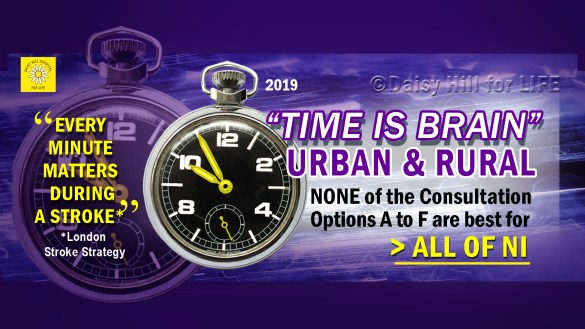
Time is Brain - Urban and Rural -None of the Options in the NI Stroke Consultattion are best for all of NI. Every minute matters during a stroke says London Stroke Strategy.

The DoH states that the proposals will have MINOR IMPACT in NI. This is not the case in Newry & Mourne, Down and South Armagh area where there will be MAJOR IMPACT on the lives of stroke patients.

There will be removal of scanning, administration of the crucially time dependant clot-busting drug Alteplase and removal of direct access into a specialist acute stroke rehabilitation unit from Daisy Hill acute Hospital as if it never existed.

This includes losing existing direct access to the Royal for Thrombectomy from Daisy Hill Hospital.

Your life could depend on it.

We must challenge the Department of Health by answering this Consultation – The more the better to get the message through loud and clear. We can do it with YOUR help.

WE CAN DO THIS TOGETHER !

Thank you.

Daisy-Hill-still-needs-you!-call-to-action-for-the-specialist-stroke-unit-in-Newry

For background information on the 2019 NI stroke Consultation document – please see the following post:

https://savedaisyhillhospital.com/2019/05/05/ni-stroke-consultation-2019-overview/

You can follow the Daisy Hill Acute Hospital campaign also by visiting and liking our Facebook page where you will find current information at https://www.facebook.com/daisyhillforlife/ – Thank you.

© Daisy Hill for Life on Facebook and http://www.savedaisyhillhospital.com, 2015 – 2019. Thank-you!

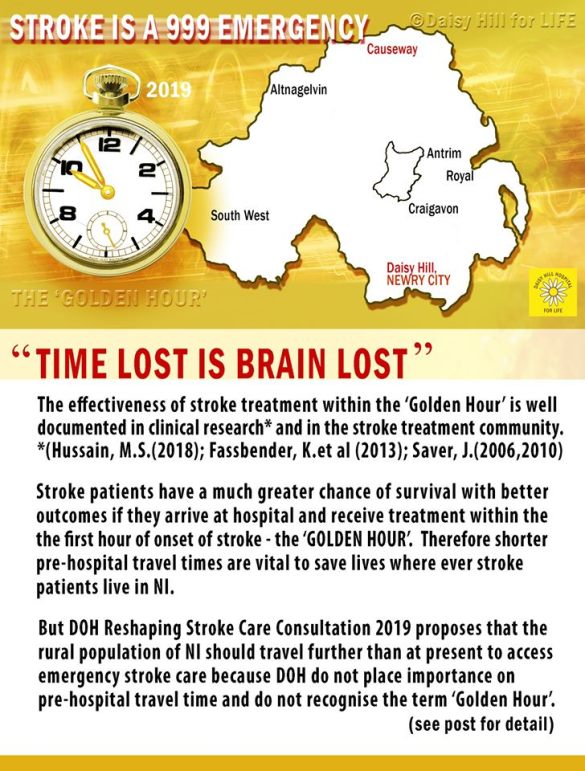
Clinical evidence proves the importance of ‘Golden Hour’ in Emergency Stroke care

The effectiveness of stroke treament within the ‘Golden Hour’ is well  documented in clinical research and in the stroke treatment community.   (Hussain, M.S.(2018); Fassbender, K.et al (2013); Saver, J.(2006,2010)

Clinical evidence proves the importance of the ‘GOLDEN HOUR’ in Emergency Stroke care, but ‘Golden Hour’ is not recognised by Department of Health (DoH).

It is well known that STROKE is a 999 EMERGENCY where every second counts for the patient receiving acute stroke care and the critically time dependant clot-busting drug Alteplase used in Thrombolysis.

The options given in the 2019 Stroke consultation show clearly that the Department of Health NI are IGNORING the fact that every stroke patient, no matter where they live, needs to be seen and treated as an Acute Stroke Care 999 Emergency ideally within the ‘Golden Hour’. This means making pre hospital travel times as SHORT AS POSSIBLE, so that the patient can ideally be treated within the ‘Golden Hour ‘from onset of stroke to needle time.
Rather than make pre-hospital travel times SHORTER, the DoH are proposing to make pre hospital travel times LONGER for patients living in Newry Mourne & Down and other areas in NI.

Stroke patients who presently are scanned in Daisy Hill (and if eligible) given Thrombolysis are already immediately transferred to the Royal for Thrombectomy if suitable.

If 2019 Reshaping Stroke Care proposals go ahead, dying stroke patients WILL BE DENIED IMMEDIATE TREATMENT and have to be transferred to Craigavon, 45 minutes away (to see if they are even suitable for Thrombolysis, never mind Thrombectomy) and will have much worse outcomes due to the delay in transfer and will be denied the best chance for survival.

TIME DELAY IN GETTING 999 EMERGENCY CARE IS NOT ACCEPTABLE

It is not acceptable that people from the Rural Areas of NI who will already have travelled long distances to access existing specialist Stroke Units, (using up precious minutes of the ‘Golden Hour’ already) will have to travel even FURTHER, losing vital brain cells and causing untold brain damage on the journey. It also means that patients who suffer a stroke when in hospital or ED will be denied access to the existing specialist Acute Stroke/Rehab Unit in Newry and denied immediate treatment.

WHY IS THE FIRST HOUR TERMED ‘GOLDEN’?

The Golden Hour in stroke is well supported by Clinical Evidence

The effectiveness of treatment in the GOLDEN HOUR is well documented in the emergency medicine and stroke treatment community, even if our DoH refuse to recognise the term ‘Golden Hour’ in the recent FAQ/ Frequently asked Questions supplement to the consultation document (see FAQ5).

It is well known that patients receiving treatment within the first 60 minutes of symptom onset, (termed the Golden Hour,) have the greatest opportunity to benefit from restoration of blood flow therapy with respect to disability and living independently. This time-frame is when the volume of salvageable brain and the patient’s capacity to benefit from clot-busting therapy are greatest.
The reason the first hour of stroke is called ‘golden’ is because stroke patients have a much greater chance of SURVIVING and avoiding long-term brain damage if they arrive at the hospital and receive treatment with a clot-busting drug called TPA (Altepalse) within that first hour from onset of stroke:

Therapeutic benefit is maximal in the first minutes after symptom onset and declines rapidly during the next 4.5 hours.” (Saver MD)

DoH DO NOT RECOGNISE THE TERM ‘GOLDEN HOUR.’

The DoH try to justify selectively making Stroke patients travel further for immediate Emergency Stroke Care during the ‘Golden Hour’ from onset of stroke in Newry Mourne & Down by stating that: “the Golden Hour is not a recognised term in Stroke Care. In our healthcare system we work to the National Clinical Guidelines for stroke, which is the definitive source of how stroke care should be delivered in the UK.”

It is the DoH’s opinion that: “The most important factor in stroke care is not the time to hospital. It is the time to expert assessment, brain scanning and treatment that is critical.” (See FAQ 5:Taken from Questions and Answers Supplement to 2019 Stroke Consultation).

The Golden Hour in stroke is well supported by Clinical Evidence

CLINICAL EVIDENCE SUPPORTING IMPORTANCE OF ‘GOLDEN HOUR’

At the International Stroke Conference 2018 in Los Angeles M. Shazam Hussain, MD, Director of Cleveland Clinic Cerebrovascular Center presented significant findings that the “golden hour” is proving to live up to its name, even for patients with one of the most serious forms of ischemic stroke.

According to this study, 52 percent of individuals suffering an ischemic stroke had better long-term outcomes if they received Thrombolysis medication (Alteplase) within 60 minutes of symptom onset. This compares to only 27 percent of patients showing good long-term outcomes – with respect to disability and living independently — if administered Alteplase beyond the golden hour.

A summary of The Lancet article (2013): ‘Streamlining of pre-hospital stroke management: the golden hour’ reinforces the importance of the narrow time-frame or ‘Golden Hour’:

“Thrombolysis with Alteplase administered within a narrow therapeutic window provides an effective therapy for acute ischaemic stroke. However, mainly because of prehospital delay, patients often arrive too late for treatment, and no more than 1–8% of patients with stroke obtain this treatment.

We recommend that ALL LINKS in the PREHOSPITAL STROKE RESCUE CHAIN must be optimised so that in the future more than a small minority of patients can profit from time-sensitive acute stroke therapy.”

The Lancet article (2013)

Therefore pre-hospital travel time for the Newry Mourne and Down population should also be shortened, not lengthened, in receiving 999 Emergency Stroke Care to save lives with better outcomes.

DAISY HILL, NEWRY IS THE RIGHT PLACE FOR A HYPERACUTE STROKE UNIT – A VITAL OMISSION FROM THE 6 PROPOSED 2019 STROKE CONSULTATION OPTIONS

Newry Mourne and Down – with a population of 180,000 is the third largest Local Government District population in NI. Daisy Hill Acute Hospital, Newry City with its STRATEGIC LOCATION – is the right place, entitled to have a hyperacute stroke unit co-located with an acute stroke unit.

This option will give a fair and equitable chance of survival with better outcomes for dying stroke patients in this LGD, like the population attending the Royal, Altnagelvin and Craigavon.

‘TIME LOST IS BRAIN LOST.

The Emergency Stroke Care “Golden Hour” is already a very narrow time-frame. Additional delay in pre-hospital travel times which the DoH are selectively imposing on the Rural Catchment population of Newry Mourne and Down will cost lives, not save saves and cannot be condoned.

The population is entitled to fair and equitable treatment, so this proposal to withdraw emergency and specialist acute stroke care from the combined Specialist Acute Stroke/Rehab Unit, which has existed since pre-2003 in Daisy Hill Acute Hospital, Newry, must be challenged!

You can follow the Daisy Hill Acute Hospital campaign also by visiting and liking our Facebook page at https://www.facebook.com/daisyhillforlife/ – Thank you.

© Daisy Hill for Life on Facebook and http://www.savedaisyhillhospital.com, 2015 – 2021. We welcome sharing of this info and the use of excerpts and links, provided that full and clear credit is given to http://www.savedaisyhillhospital.com and Daisy Hill for Life with appropriate and specific direction to the original content. Thank-you!

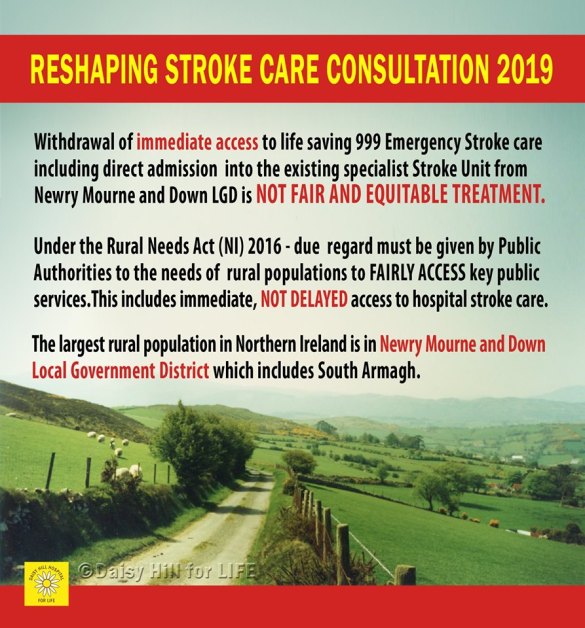
Largest rural population in NI: Newry, Mourne and Down Local Gov. District must have immediate access to life saving 999 Emergency Stroke Care

Withdrawal of immediate access to life saving 999 Emergency Stroke Care, including direct admission into the existing specialist Acute Stroke Unit from Newry, Mourne & Down Locality is not fair and equitable treatment. Under the Rural Needs Act (NI) 2016 due regard must be given by Public Authorities to the needs of rural populations to fairly access key public services. This includes immediate, not delayed access to hospital stroke care. The largest rural population is in Northern Ireland is in Newry, Mourne & Down Local Government District which includes South Armagh.

Under the Rural Needs Act (NI) 2016 due regard must be given by Public Authorities to the needs of rural populations to fairly access key public services. This includes immediate, not delayed access to hospital stroke care.

The largest rural population is in Northern Ireland is in Newry, Mourne & Down Local Government District which includes South Armagh.

Since 2018, the Rural Needs Act 2016 (NI), which aims to deliver fairer and more equitable treatment in Rural areas, must be adhered to by all Public bodies in NI. Because of this, the Dept. of Health filled in a Rural Needs Assessment Form to accompany the 2019 NI Stroke Consultation.

Definition of Rural in Rural Needs Assessment Form

On this form, the definition of “Rural” which according to the DOH “is better able to distinguish between those who will be MOST IMPACTED by additional travel times caused by proposed changes to services is:
“Populations outside of a 30 minute drive time of Derry/Londonderry or Belfast”

Using the above definition confirms that the 5 Urban hospitals in the Stroke Consultation 2019 are:
Altnagelvin, Royal Victoria, Craigavon, Antrim and Ulster hospitals,
while there are only three Rural Acute hospitals:
Daisy Hill, Newry, Causeway Hospital, Coleraine and South West Hospital, Enniskillen.

The DoH’s reply to Question 2B in the Rural Needs Assessment states:

“The key impact that differently affects rural dwellers is likely to relate to travel times to hospital etc.” They continue:
ALL OF THE OPTIONS outlined in the consultation document INCLUDE the provision of hospital care” at “Altnagelvin, Craigavon and Royal Victoria Hospital” (all URBAN Sites.) “Therefore people living in the catchment areas for these three sites WILL NOT experience any increase in respect of travel times. Under the potential options, people living in the catchment areas for Causeway Hospital and Daisy Hill Hospital, WOULD experience an INCREASE in journey times if taken to hospital after a suspected stroke.

INCREASE IN JOURNEY TIMES AFTER A SUSPECTED STROKE FOR RURAL CATCHMENT AREAS

From research by Werner Hacke, MD It is known that the drug “Alteplase” used in Thrombolysis, is nearly twice as effective when administered WITHIN the first 1.5 hours after stroke as it is when administered 1.5 to 3 hours after stroke.

Yet, The DoH have admitted, above, that there WILL BE AN INCREASE IN JOURNEY TIMES for people living in the Rural Catchment areas of Causeway and Daisy Hill hospitals, and that people living in the Urban catchment areas of Altnagelvin, Craigavon, and Royal Victoria hospitals WILL NOT experience any increase in respect of travel times.

They have decided also to WITHDRAW COMPLETELY the existing stroke units in the Rural Locations of Daisy Hill Acute Hospital, Newry and Causeway Hospital, Coleraine. This proposal means dying stroke patients from these Rural localities will have to TRAVEL FURTHER for the CRITICALLY TIME DEPENDENT, LIFE-SAVING drug Alteplase used in Thrombolysis, and direct access from ED into the existing combined Specialist Acute/Rehabilitation Stroke Units in Daisy Hill, Newry, and Causeway Hospital, Coleraine, essential to save lives.

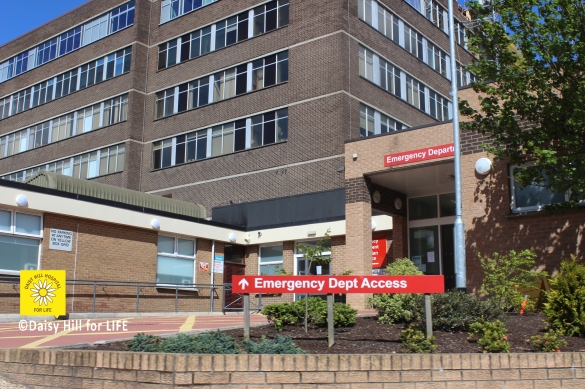
Daisy Hill Hospital Emergency Department is vital for stroke and life threatening emergencies

The 3 Urban Hospitals Altnagelvin, Craigavon, and Royal Victoria will never experience an increase in travel times because they feature in all 6 Options in the 2019 Stroke Questionnaire to be upgraded to Hyperacute stroke units with co-located Acute Stroke Units.

RURAL HOSPITALS OF DAISY HILL AND CAUSEWAY OMITTED FROM ALL SIX OPTIONS

However the two Rural hospitals of Daisy Hill and Causeway have been omitted altogether from all six options, confirming they will be shut down as if they never existed as part of the network providing 999 Emergency Stroke care to the population of NI.

THERE ARE NO RURAL HOSPITALS INCLUDED IN ALL 6 OPTIONS FOR HYPERACUTE AND ACUTE STROKE UNITS.

The DOH forget that Rurality is a factor in allocating Health and Social Care Funding which means that there is extra money to provide services in Rural areas which should be taken into account in deciding where stroke Units will be provided.

*********RURAL NEEDS ACT (2016)*************

To have Three Hyperacute stroke units for Urban Areas of NI in all 6 Options and NO Option for a Hyperacute Stroke Unit for the Catchment population for the LARGEST RURAL POPULATION in NI namely Newry, Mourne & Down (which includes S.Armagh) Local Government District is NOT FAIR AND EQUITABLE TREATMENT in revising policies, strategies and plans, and designing and delivering public services such as Acute Stroke Care under the 2016 Rural Needs Act.

The Rural Needs Act NI 2016, (which is not a devolved matter) is there to PROTECT the Rural Population from this unfair treatment and “can relate to the ability to access key public services such as health, the ability to access suitable employment opportunities, and the ability to enjoy a healthy lifestyle”.

NEWRY MOURNE & DOWN LOCALITY SHOULD ALREADY HAVE A MAJOR ACUTE HOSPITAL

Just as in the Western Trust (with a total population of 301,448*) there is need for TWO Specialist Acute Stroke Units - so too, the Southern Trust (with a larger population of 380,312*) is also entitled to TWO Specialist Stroke Units (HASUs and Acute Stroke Units), at Daisy Hill Hospital, Newry and Craigavon Hospital. This would ensure that everyone in the Southern Trust has immediate access to CT scanning and life saving thrombolysis, followed by direct access into a stroke unit.

There is no doubt that Newry Mourne and Down LGD with the largest Rural population in NI with 179,000 people, SHOULD ALREADY have a major acute hospital, in Newry as proposed by Secretary of State Peter Hain in 2005.

This Stroke consultation shows that the Department of Health are not even prepared to give dying stroke patients from the largest rural Population in NI, the basic essential need of immediate access to Emergency Stroke Care.

The Rural catchment population for Daisy Hill Acute Hospital, Newry, is not being treated fairly and equitability in the same way as the catchment population of the Urban Stroke Units in Altnagelvin, Craigavon and Royal Victoria Hospitals who will have immediate access, as they should, to life saving stroke care, in Hyperacute and Acute Stroke Units without having to travel further than at present.

This deliberate plan to exclude the Rural populations need for IMMEDIATE, not delayed, access to life saving Emergency Stroke Care, including CT scanning and Thrombolysis, followed by direct access into a specialist Hyperacute Stroke Unit /Acute Stroke Unit will COST LIVES, not save lives of Stroke patients and should not be condoned.

. . . . . . . . . . . . . . . . . . . . . . . . . . . . . .
BACKGROUND INFO
Link to Rural Needs Act 2016
https://www.legislation.gov.uk/…/19/pdfs/nia_20160019_en.pdf

“RURAL NEEDS ACT (NORTHERN IRELAND) 2016
Duty of public authorities to have due regard to rural needs
1.(1) A public authority must have due regard to rural needs when— (a) developing, adopting, implementing or revising policies, strategies and plans, and (b) designing and delivering public services.
6. In this Act— “the Department” means the Department of Agriculture and Rural Development; “rural needs” means the social and economic needs of persons in rural areas.”
‘PUBLIC AUTHORITIES’ include:
A Northern Ireland department
A district council
A Health and Social Care Trust
Invest Northern Ireland
The Regional Agency for Public Health and Social Well-Being
The Regional Health and Social Care Board

Urgent! hospital planning Applications for Daisy Hill Hospital, Newry; and Craigavon are on NI Planning portal to view

Act Now for Daisy Hill Hospital, Newry

Daisy Hill Hospital, Newry & Craigavon Hospital, Portadown Plans on NI planning Portal

Important hospital planning news: One refurbished ward for Daisy Hill, Newry and a new stand-alone Paediatric Unit in Craigavon – the start of Craigavon’s NEW HOSPITAL master-plan.

Southern Health Trust’s proposed plan for Craigavon’s new hospital and centralised children’s hospital services in Newry & Mourne, Armagh, Dungannon, South Tyrone, Banbridge and Craigavon is now at Planning Stage. Todd Architect’s proposed plan states: “The new stand-alone paediatric unit is the first building project in a proposed phased MASTER PLAN DEVELOPMENT for the Craigavon HOSPITAL SITE.. positioned as a gateway to the NEW HOSPITAL future entrance.”

Daisy Hill Hospital has been announced in the press as a proposed new Centre of excellence for Children but a comparison of the two Plans reveal that Daisy Hill is proposed a 19 bed re-development of the existing stroke ward on Level 6 to change to a children’s ward – while Craigavon Plan proposes a new stand-alone building with a Paediatric Unit with 5 consultants offices and more.

View these Planning Proposals at ni.planning.gov.uk Planning portal
This portal is sometimes hard to search – For faster direct access to plans portal ignore Ref number etc and Search using >Application details tab then select Ward = Ballybot for Daisy Hill and select Ward = Kernan for Craigavon.
Planning applications including: a detailed description, plans, maps and drawings are available to view on the Planning NI Web Portal www.planningni.gov.uk or at the Local Area Planning Office or by contacting NI Direct on 0300 200 7830. Written comments should be submitted before 24th July. Please quote the application number in any correspondence and note that all representations made, including objections, will be posted on the Planning NI Web Portal

© Daisy Hill for Life on Facebook and http://www.savedaisyhillhospital.com, 2015 – 2017. We welcome sharing this info and the use of Excerpts and links, provided that full and clear credit is given to http://www.savedaisyhillhospital.com and Daisy Hill for Life with appropriate and specific direction to the original content. Thank-you!
Future of Hospitals in Northern Ireland

heart monitor

Image courtesy of jscreationzs at FreeDigitalPhotos.net

The Donaldson Report feature on DHSSPSNI

Take notice! Is Northern Ireland a democracy or not? The future of all hospitals in Northern Ireland is being decided.   It seems Lord Donaldson expects the Northern Ireland public to pay an international panel of experts ( picked by who?) to sort out the hospital and healthcare needs of nearly 2 million people, without question from anybody.   This Report implies that our devolved government and MLAs should have no say on the future of our hospitals and that all decisions should be made without their (and consequently the electorates) say.
The Patient and Client council gives a summary of Recommendation 1 of Donaldson Report: “Recommendation 1: Coming together for world-class care”- “We recommend that all political parties and the public accept in advance the recommendations of an impartial international panel of experts who should be commissioned to deliver to the Northern Ireland population the configuration of health and social care services commensurate with ensuring world-class standards of care.”
The DHSSPS states – “You are now invited to share your views on the recommendations from the Donaldson Report.” –Responses must be received no later than Friday 22 May 2015.
Background info from DHSSPS:
“On 8 April 2014 former Health Minister Edwin Poots announced his intention to commission former Chief Medical Officer of England, Professor Sir Liam Donaldson, to advise on the improvement of governance arrangements across the HSC.
Sir Liam was subsequently tasked with investigating whether an improvement in the quality of governance arrangements is needed and whether the current arrangements support a culture of openness, learning and making amends.
Sir Liam’s report was published by Minister Jim Wells on 27 January 2014 in conjunction with an Oral Statement to the Assembly. The report set out ten recommendations which refer to a wide range of areas across the health service.”

http://www.dhsspsni.gov.uk/showconsultations?txtid=76505